Publishing Frontiers and Fundamentals and Other Take-Aways from TAP2013

Technologically Advanced Publishing (TAP2013) Conference: Digital publishing, e-publihing, electronic publishing, and more.

NAIWE was a media sponsor of TAP2013 in Orlando.

I’m just back from the Technologically Advanced Publishing (TAP) Conference with a light sunburn and a head full of ideas for using what I learned.

For this event, I focused on learning in a completely new-to-me area– the publication of apps for iPad and iPhone, but absorbed information about many other aspects of the business of electronic publishing in workshops such as:

  • How to Start and Finish Writing Your Book – Richard Harrington (“Use the sticky note program on your computer to do informal mind-mapping before you start to write. You can drag notes around until you have an outline.” JPC note: I do the same thing in the slideshow view of Keynote.)
  • Design & Digital Publishing Essentials – Terry White (“When creating an app, be sure to indicate navigation points– tap, swipe arrows, etc.”)
  • Establishing Your Brand and Visual Identity Across Multiple Social Media Platforms – Rod Harlan (“Be consistent in how you present your brand. Coca-Cola has done a great job of telling its history through its Facebook timeline.”)
  • Copyright Still Means Something for Digital Publishers – Jeff Heninger
  • iBooks Author Fast Start - Richard Harrington (“An iBook is a container. It can include media widgets with slide shows, tutorials, etc. Short is good.”)
  • ePub, pPDF, or DPS: Which Format to Choose? – Colin Fleming (“The format– print book, ebook, app– is simply the container for information or story. Choose which will best fit your audience and content.”)
  • Hypersyndication: How to Deliver Your Content to Multiple Platforms – Richard Harrington (“I am one of the laziest but most productive people on the planet.” and “Give away 25% of everything you do.”)
  • User-Generated Content is Great (and full of Legal Problems) – Jeff Heninger (“In social media you’re one click away from forever.”)
  • Creating a Video Trailer for Your eBook or App Using Photoshop – Rod Harlan
  • Getting Started with Digital Publishing Suite (DPS) - Colin Fleming
  • Creating ePUB files with Adobe InDesign - Colin Fleming

In addition, there were five memorable keynotes:

  • Guy Kawasaki – Author, Publisher, Entrepreneur
  • Scott Kelby – View from the Inside (“You self-publish to take control your content. Do it because you want to change the world, not because you think it’s the next big thing.”)
  • Skip Cohen – It All Starts with a Blog (Your blog is your home on the web. Build it and develop an audience now.)
  • Debbie Bates Schrott – Digital or Die: The Case for Captivating UX & Design to Bring Your Content to LIfe (“Use a flow chart to space out interactive elements such as slideshows, video or audio elements, quizzes, feedback forms, etc., when planning an app.”)
  • Jessica Meher – Inbound Marketing: The Secret to Your Success (“The businesses that the best educators will most successful.”)

And finally, there was an exceptionally creative idea implemented one afternoon– an UnConference with short, 15-30 minute presentations on a single, narrow topic. I presented “Write Your Way to Multiple Streams of Income: The 15-Minute, Five-Stage Business Plan,” and attended:

  • Creating Synergy Between Blogs, Books, and Workshops – Syl Arena
  • The Marines Magazine App: How We Did It – Debbie Bates Scrhott & Darrly Sebro
  • TAP into Actual Returns from Social Networking – Levi Sim (“Be a person; be a good one. Ask “what would grandma do?”)
  • Digital Sustainability – Alan Brusky

APE: How to Publish a Book by Guy Kawasaki and Shawn Welch - Author, Publisher, EntrepreneurIn addition to a pocketful of business cards, I brought home a copy of APE: Author, Publisher, and Entrepreneur: How to Publish a Book by Guy Kawasaki and Shawn Welch. It’s not only practical, straightforward, and well-written, but it also gets specific about the technology and services you will need. With a copy of APE at your elbow, you’ll be able to transform the manuscript in your desk drawer to a new stream of income. I recommend it.

Do I remember everything I learned? Not a chance. But I took lots of notes and plan to visit many of the links and websites that were referenced. You’ll find those links, along with a selection of other resources I think are essential for learning more about digital publishing, electronic publishing, or whatever you want to call it, in the next post. Enjoy!

Share

The NaNoWriMo Song

Every event needs it’s own song, so here’s the soundtrack for National Novel Writing Month, aka NaNoWriMo. Vocals, Electric Guitars, Bass, Irish Bouzouki, Glockenspiel, Organ, Drum Programming– it’s all by John Anealio, specialist in geeky anthems, for NaNoWriMo 2011.

NaNoWriMo
John Anealio
Share

Writing Advice from Ray Bradbury

Author Ray Bradbury has done it all– novels, non-fiction, short stories, and more. In “Telling the Truth,” the 2001 keynote address at Point Loma Nazarene University’s Sixth Annual Writer’s Symposium by the Sea, he shares frank, practical writing advice. He’s laugh-out-loud funny, occasionally profane, but his advice is profound and well worth absorbing.

Here is a quick outline of a few primary points. Don’t miss his talk, though. It’s peppered with wonderful anecdotes, interesting people, good humor, and vivid language.

  1. Write short stories, not novels, first.
  2. You may love another author, but you can’t be them.
  3. Study high-quality short stories by classic authors (he provides specific recommendations).
  4. Stuff your head with good stuff.
  5. Fire the friends who don’t support you.
  6. Live in the library, not in front of a screen. He “graduated from the library.”
  7. Fall in love with old movies.
  8. Do what you do with love, and write with joy. If writing starts feeling like work, scrap it and start something else.
  9. Don’t focus on making money, but on writing. The story of his trip to New York City and the sale of his first two books is inspiring.
  10. You can deal with the ten things you love, hate, fear, or almost remember by writing them into stories.
  11. Surprise yourself. Type what comes into your head–intuition and word association can spark many ideas. You don’t know what is in you until you test it. Bradbury said his first film wasn’t good, but it was a beginning.
  12. You write for readers. What you’re writing for, even if you don’t know it, is for at least one person to love what you do. And you must love it too.

I love his opinionated commentary about short story writers, perhaps because he shares my taste for classic authors, metaphors, and stories that go somewhere.

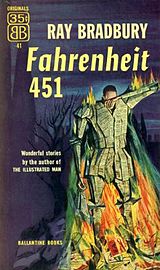
If you've never read anything by Ray Bradbury, my pick for "must read" is Fahrenheit 451.

My favorite tip is to “stuff your head with good stuff.” He suggests that if you read one short story, one good, classic poem, and one essay before bedtime for the next one thousand nights, you’ll have a wealth of material to work with. I’ve been teaching for years that “input must come before output,” and Bradbury offers concrete examples of how to make it happen.

Bradbury’s joy in reading and writing are contagious, and mental snapshots of dandelions, King Kong, Bill Gates (“I don’t do Windows”), an enthusiastic barber, a destroyed face, and Gene Kelly are vivid reminders of his gift. This video is part of the University of California Television (UCTV) series.

Libraries raised me. I don’t believe in colleges and universities. I believe in libraries . . . I went to the library three days a week for 10 years. (Ray Bradbury)

Share

How to Find What You’re Meant to Do

Sometimes it’s not a lack of skill or motivation that keeps freelancers stuck, doing mundane jobs and wondering why they haven’t discovered their ideal business focus. Sometimes it’s just that they haven’t considered linking their personal passion with the work that they do every day. Here are three simple questions you can ask that will help you clarify where you’d like to take your career.
Share

Doing the NAIWE Summer Challenge 2011

NAIWE Summer Challenge 2011It’s halfway through summer, and I’ve just decided what I want to do for the challenge. Remember, it’s a way to “get more done than you thought possible,” so I felt free to post a formidable list of books, rather than just the required three.

The three parts of the challenge are:

  1. Read three books that will stretch your mind and inspire your creative spirit.
  2. Finish one project that’s been nagging at you for longer than you care to admit.
  3. Brainstorm a new project that will bring you an additional stream of income, then take the first step to make it happen.

Read more about the challenge at the NewsWire blog.

I posted my reading list and projects at Do What Matters, Make it Pay, my blog for writers and creative entrepreneurs. It’s a fairly new blog created in response to increasing requests for practical, down-to-earth information on how to create multiple streams of income while keeping the life you love, so you may want to subscribe to it.

So . . . click here to read my response to the NAIWE Summer Challenge. The first book I’m reading is The Creative Entrepreneur: A DIY Visual Guidebook for Making Business Ideas Real by Lisa Sonora Beam.

I chose it because I’ve spent several years reading serious, heavy business books, and was looking for something a bit different. So far, Sonora Beam’s advice is spot on, and I’m enjoying the colorful, creative format. I think it will be a book I can recommend to other creative entrepreneurs. It certainly makes me want to pull out my art supplies and creatively refocus!

Where do you plan to start?

Share

Time to “Do the Next Thing”- My New Year’s Resolution

I’m not inclined to get too detailed with my New Year’s Resolutions, and this year is no exception. Four words is all it takes to sum up my intent for 2011. Here’s what it’s all about:

Do this. Don’t do that. Be this. Don’t be that…

New Year’s resolutions sometimes sound like the barking of a Marine sergeant dealing with raw recruits on a sub-zero morning. Personally, I’m a fan of warm covers on sub-zero mornings, and I tend to ignore barking of any kind (just ask my terrier). But I still like to go through the process of thinking back over the previous year, considering what went well and didn’t, and focusing on what I’d like to make happen in the new year.

I’ve discovered that simple is usually better when it comes to resolutions, so I try to boil down what I want to accomplish into one sentence. This year…. Read more….

Share

5 Good Reasons to Go to a Writers Conference

I enjoyed the James River Writers Conference in Richmond last weekend, and am combing through my notes for all the good ideas I wanted to apply. There are a lot of them, but they’re all lining up after the non-fiction proposal I have to finish and send. The best part of the conference was just being around so many other people who loved to write. We could talk writing morning, noon, and night, and no one started yawning after the first sentence!

Whether you’re an established writer or just getting started, a writers conference is a great place to be. Here are five good reasons to go: (Read more…)

Share

Killing Two Birds With One Stone: NAIWE Challenge Serendipity

NAIWE 2010 Get it Done Summer Challenge

I had a few rough ideas of what I’d like to accomplish for the NAIWE 2010 Get it Done Summer Challenge. If you haven’t checked it out, the three parts of the Challenge are:

  1. Read three books that will stretch your mind and inspire your creative spirit.
  2. Finish one project that’s been nagging at you for longer than you care to admit.
  3. Brainstorm a new project that will bring you an additional stream of income, then take the first step to make it happen.

I read Sheri McConnell’s Smart Women Know Their Why (reviewed here) for the first of my three books, and have a teetering stack from which I can choose the remaining two official Challenge books. This is the easiest part, because I know that before summer is over, I’ll have read quite a few more than three books. I schedule morning and evening reading times so that I can bracket each day in knowledge, inspiration, and sometimes, just plain fun. Read more…

Share

Final Thoughts on the SCBWI Winter Conference 2010

I enjoyed my first national SCBWI conference in NYC a couple of weeks ago. It was exhilarating to be in the same room with so many creative people–writers, illustrators, publishers, agents, editors, and other children’s book enthusiasts (Jane Yolen!!!). While there, I was conscious of the fact that just being there conferred an advantage on each hopeful writer or editor in attendance. There’s nothing quite like the synergy of being present, networking in person, and hearing first-hand from others in the field.

I tweeted many of the tidbits I picked up during the conference, but several things have lingered with me. Here are a few of them: Read more…

Share

The Freedom to Write

I was captivated by some thoughts on freedom and writing that Moira Allen, editor of the Writing-World.com newsletter shared in her most recent issue. This excerpt is reprinted here with her permission .

She writes:

“…Writing is, at the most fundamental level, about freedom.
Countries that wish to restrict the freedoms of its citizens
invariably get around to restricting the freedoms of writers.  One
of those things that I DO take for granted is the freedom to write
what I want, without fear of having someone knocking on my door
late at night — or worse, without the fear that someone has a
right not only to knock but to enter, without a warrant or anything
resembling “just cause.”

Governments that don’t like freedom don’t like writers — because
writers have this nasty tendency to tell the world all about what
their governments are doing.  Frankly, I sometimes get tired of our
press complaining nonstop about our government — but I will never
get tired of the fact that the press CAN complain!

There is no power on earth as important as the freedom to be able
to say, and write, whatever you wish.  There is no gift so great
for writers to celebrate in this holiday season as the freedom that
we have, at least in this country, to WRITE.  That freedom means
that we have the power to speak up about things that we don’t like
– and the power to demand and make changes to the world in which
we live.  It is the gift that makes the difference between being
“citizens” rather than “subjects.”  Many of us may never feel the
need to exercise the full power of this gift, but we should never
forget that we have it.  And we should also never forget those who
don’t.

It’s also something that we can pass on.  Whenever you help someone
develop their writing skills — whether it’s your own child, or a
total stranger that you’ve met through an Internet writers’ group
– you’re passing on more than just the ability to craft a better
sentence.  You’re passing on a gift of freedom.”

Moira Allen is the editor of Writing World newsletter, and the manager of the enormous Writing-World.com website. I’m grateful for the opportunity to reprint her thoughts here.

Share